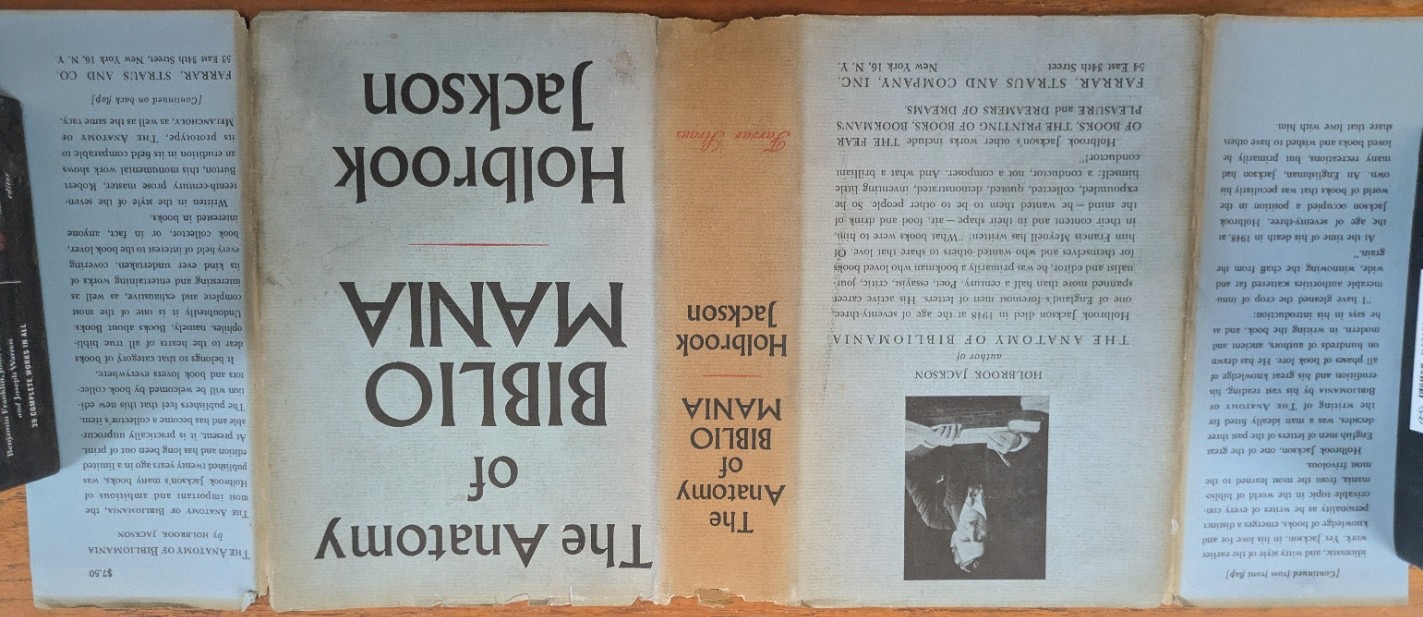
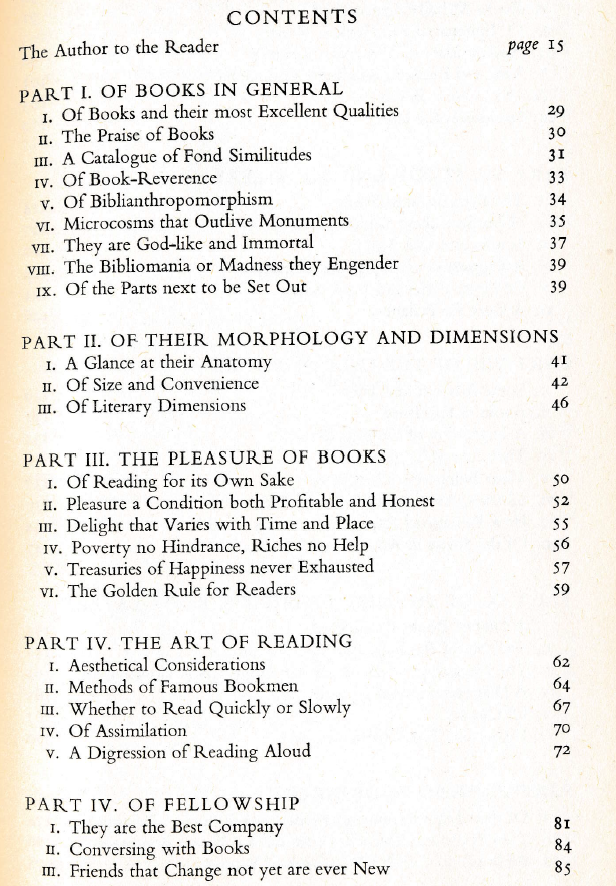
Through some beautiful serendipity, at the tail end of my efforts to catalog my home library, I ran across a volume by Holbrook Jackson, The Anatomy of Bibliomania (1950). I didn’t remember this book at all, and had no memory of purchasing it, though it somehow wound up in my collection. But what a treasure it is! Jackson, an Englishman, was an eminent man of letters in his day, roughly the first half of the twentieth century. He is, as a writer, alternately zany and profound. In his 650-page treatise, he examines books from every possible angle, stating his purpose as follows:
My purpose in the following work is to discourse of the nature, excellences, uses, and diseases of books, and particularly to anatomize this humour of Bibliomania, through all his parts and species, as it is an habit, or a disease; and philosophically and medicinally to show the causes, symptoms, signs, expressions, meanings, manifestations, eccentricities, vanities, impudences, and, where expedient, the cures, for ’tis plain to conceive that it is often a genial mania, less harmful than the sanity of the sane, and most happy when endemic with moderation in the constitution of a man.
In doing so, I have described and opened up, as by a kind of dissection, not only those peccant humours (some of them) which have given impediment to the proficiency of learning and occasion to the traducement of the love of books, but also those more robust passions which are proper to bibliophilia: wherein, if I have been too plain, it must be remembered, ‘Faithful are the wounds of a lover, but deceitful are the kisses of an enemy’1: to be true to any subject without frankness is impossible. These methods and motives at this present have induced me to make choice of the subject.
Jackson devotes many pages to the joys of books. Of John Aikin he says
that without books he had never been able to pass a single day to his entire satisfaction; for they are at the head of all the pleasures which offer themselves to the man of liberal education; in variety, durability, and facility of attainment, no other can stand in competition with it; and even in intensity it is inferior to few; and he supports his argument by the supreme fact that books give us the power to call up the shades of the greatest and wisest men that ever existed, and oblige them to converse with us on the most interesting topics; ’tis an inestimable privilege, he well says, and superior to all common enjoyments; and an added advantage that from this feast of the choicest thoughts of the ablest men in their best dress, we can exclude dullness and impertinence, and open our doors only to wit and good sense. . . .
The delight of learning is foremost in the uses of books, though Jackson concedes they may be used as furniture, or adornment, or even as missiles to throw at another person, nay as weapons of war.
In any catalogue of the uses of books, high place must be given to the delight of knowledge and learning, which, as some point out, surpasseth all other in nature, for in all other pleasures there is satiety, and after they be used, their verdure departeth; which showeth well they be but deceits of pleasure, and not pleasures: and that it was the novelty which pleased, and not the quality; therefore we see that voluptuous men turn friars, and ambitious princes turn melancholy. But of knowledge there is no satiety, satisfaction and appetite being interchangeable.2 To most kind of men it is an extraordinary delight to study, says Robert Burton,3 for what a world of books offers itself, in all subjects, arts, and sciences, to the sweet content and capacity of the Reader! It is, indeed, a world of endless exploration and uncountable adventures, full of strange countries, peoples, animals; wonders, beauties, terrors, astonishments; it has treasures and riches; curiosities, freaks, fantasies, monsters, hobgoblins, fays, gnomes, satyrs, nymphs; trees, flowers,
With buds, and bells, and stars without a name,
With all the gardener Fancy e’er could feign,
Who breeding flowers, will never breed the same;4a world without end, for all that Mankind has done, thought, gained, or been, is lying as in magic preservation in the pages of Books.5
Jackson insists that good readers are as vital as good writers, explaining at length the qualities requisite in such. He is especially enamored with Montaigne and Petrarch.
No better examples of good bookmen can be found or put up than those of Montaigne and Petrarch, and I set their names here as typical of all great readers, worthy to be masters and leaders in our adventuring. Montaigne swings eloquently to my purpose as a true indication of sanely varied and self-centred book-taste . . . He was not a regular, laborious student; he loved, like our own Dr. Johnson, to sip here and sample there; to roam and browse and chew the cud. He frankly admits a preference even for desultory and idle reading, which so many are apt to condemn, but which has its place, to my thinking. . . I have no complaint, his tastes were his own, and his whims were tastes, revealing him to himself and to us; for more, read his essay Of Bookes, where he discourseth at large on these matters; and compare if you will Petrarch, a great reader of another kind, who as the herald of the Renaissance of Ancient Literature, made the Greek and Latin Classics his close friends, Virgil, Ovid, Seneca, Aristotle and Valerius Maximus closest of all, despising for the most part the works of the Fathers, whose dominance he helped to end.
Into the midst of this galaxy of Pagan stars he brought St. Augustine’s Confessions, bubbling over with tears, which he read continuously for forty years; he loved the Confessions with passion and fidelity, it was his Bible, and dearer to him than the dearest of his beloved Classics: few things in the history of literature are more touching than this spiritual comradeship—Petrarch clasping hands with St. Augustine across the Lethe of nine medieval centuries, the last man of the classic age and the first man of the modern mingling their souls in sympathy and sentiment.
Jackson wrestles frequently with his own originality, knowing to his bone that he got it all from someone else. He acknowledges himself to be in abject imitation of Robert Burton’s The Anatomy of Melancholy (1621), and feels compelled to justify his decision to lay yet another book before the public:
That there is a vast chaos and confusion of books I have no doubt, and that our eyes ache with reading, our fingers with turning, I do not deny; nor can I deny that I have risked censure by becoming one of the mob of producers. I do not deny it, and I have only this to say for myself, as Burton said of his book,6 Omne meum, nihil meum, ’tis all mine and none mine. As a bee gathers wax and honey out of many flowers, and makes a new bundle of all,
As bees sip from every flower in blossom-filled glades,7
I was ever wont to intermix with mine own work some ornaments from the works of others, and I have laboriously collected this fardel out of divers writers, and like him, sine injuria, I have wronged no writer, but given every man his due; and thus citing and quoting mine authors, I am no thief; I have taken, not stolen; and what Varro8 speaks of bees, that they are not malicious, because they cause no injury to the flowers which they rifle, on the contrary, they give more than they take,9 I can say of myself; whom have I injured? It would be as untrue to say of me, as Montaigne alleged might be said of him: that here I have but gathered a nosegay of strange flowers, and have put nothing of mine into it, but the thread to binde them.10
As for what constitutes a good and sufficient reason for loving books, Jackson emerges as something of a latitudinarian:
I accept pleasure, suavity, jocundity, and other terms of the like import, for one and the same thing in the rules of reading, as the Epicureans do in their rules of life.11 The inference is exceeding plain, for if a book is not pleasurable it is unreadable and thus defeats its aim, which, as I have said, and will say again, is to be read. It is equally evident that this pleasure of books is widespread and diverse, for they not only delight us to the marrow,12 profoundly move, or exalt us up to heaven, but they entertain the passing fancy, the light and evanescent whim; so let every one take the view (or the book) which pleases him, and enjoy it13 . . .
In these as in other affairs the golden rule is that there are no golden rules;14 nothing against a good stomach, as the saying is: we must take our choice, refraining rather by experience of ill than by precept of good: live and learn, until good taste is formed, then you may with safety side with Philodamus when he sings:
Philosopher, whom dost thou most affect,
Stoics austere, or Epicures’ sect?
Friend, ’tis my grave infallible design
With those to study, and with these to dine:15Generally, thus much we may conclude, with Bronson Alcott,16 that that is a good book which is opened with expectation and closed with profit, provided we agree that profit may differ in kind with every good book, being sometimes a pearl of wisdom, at others a golden vision, sometimes the silver of happiness, anon the bronze of information; nor would I despise that most fickle of all profits, entertainment, when
words themselves
Move us with conscious pleasure;17all the more so because, as Viscount Grey has it, the deep and abiding pleasure of reading increases the more it is had, actually refreshes and restores as well as entertains.18 But apart from all high-minded arguments, amusement has its place. ’Tis better many times to be entertained than improved, and to play the fool now and then is not amiss, for it is just as well to be a little giddy-pated, if we are to feel at home on this teeming earth.19 There is time for all things.
I have friends who have suffered from Alzheimer’s, a terrible scourge, and no person past the age of seventy can banish the fear that one day it will come for them. But our man Jackson pays tribute to the feats of which old age is capable, reminding us that if you don’t use it you’ll lose it.
Michelangelo was so proud of his capacity for study in extreme old age, that he is said to have invented the device representing an old man in a go-cart bearing an hour-glass and the inscription Ancora imparo, I am still learning. Ludovico Monaldesco, at the extraordinary age of 115, wrote the Memoirs of his times, and La Casa bragged, in a letter to a friend, that he would go on making sonnets twenty-five or thirty years after his death. As this may be no more than a fantastic boast, I shall resolve this chapter with Adam Smith, who contends that of all the amusements of old age, the most grateful and soothing is a renewed acquaintance with the favourite studies of youth, and as he said it Sophocles and Euripides lay open before him for proof. How many such encomiums I might add out of the histories of scholars and learned men is so well known to all experienced readers, that I need not examine further particulars, for there are few who will dispute that the intellect and the soul require support as well as the body, for they are like lamps: unless you feed them with oil, they too go out from old age.20
For all that Jackson idolizes books, he severely chastises vain and pedantic characters who use books as ornaments, showing how much they are reputed to know.
Some read to think,—these are rare; some to write,—these are common; and some to talk,—and these form the great majority.21 There are others, and many of them, that eschew all reading except for vainglory,
Who read huge works to boast what they have read,22
to disport their second-hand stock of ideas and information, for a fading greedy glory, to cousin and delude the foolish world;23 to peacock themselves at large, like Æsop’s daw in borrowed feathers. Among them are others who
Affect all books of past and modern ages,
But read no further than the title-pages.24
Jackson recalls the Roman nomenclators (nomenciators, or “caller of names”), enslaved attendants who reminded Roman big shots of the names of common folk, so as to feign familiarity. Some noblemen, Montaigne argued, even had
in their retinue tame pedants to prompt them, should they at any time move among friends who desired to speak on matters pertaining to scholarship. Then came the pedants’ chance; they were rushed up to fill learning’s breach: some with discourse, some with a verse of Homer, othersome with a sentence, each one according to his skill or profession. These rich Romans persuaded themselves that all such learning was their own because it was contained in their servants’ minds: whose sufficiencie is placed in their sumptuous libraries. When asked what they know, they will require a book to demonstrate the same;25 one durst not tell me that his posteriors are scabious, except he turne over his ‘lexicon’ to see what posteriors and scabious is.26 They take the opinions and knowledge of others into their protection, and that is all; such knowledge is not enfeoffed and made their own, as it should be. They recall one who, having need of fire, goes to his neighbour’s house rather than light his own. What availes it us to have bellies full of meat, if it be not digested? If it be not transchanged in us? except it nourish, augment, and strengthen us?
These passages do eerily remind me of our relationship with AI. Have not our rich oligarchs persuaded themselves that all such learning is their own because it is contained in their servers’ vaults?
Jackson makes a sharp distinction between bibliophilia and bibliomania. The former is grand, whereas the latter is a disease, an unnatural condition, “an inordinate, extravagant, excessive traffic or association with books,” though “of all species of afflictions it has the least moral turpitude attached to it.” The bibliomaniac, or “the bibliomane proper,” has an “intemperate attachment to books, which he will acquire at any cost and hoard in any quantity, for avarice or some animal instinct,27 regardless of their use as instruments of learning or delight: they have but one idea, but one love, but one passion: books.”28 He gives various examples of this madness, including one Englishman who accumulated 147,000 books and who had, before his death, forbidden even close friends a glimpse of his holdings. He says of such men that “they are all out for possession per se, becoming slaves of their collections. They amass books not for use but from the lust of possession,” making bibliomania a “perverted bibliophily.”
Jackson draws innumerable distinctions between bibliophilia and bibliomania, though acknowledges that the distinction may be less than sharp in some cases. He concedes that “the most illustrious of bibliophiles is not immune from insanity, not, in fact, always free from taint, for we that are true lovers, run into strange capers.” With Emerson, he holds
that books take rank in our lives with lovers and passionate experiences,29 for as men live for books so will they die for them, as Cassius Severus, an eloquent Roman, seeing his books burnt, exclaimed that by the same sentence he also should be condemned to be burnt alive.30 Greater love hath no man.
When most people hear the word “love,” they think of sex, but Jackson has no patience for those who reprobate talk of love in connection with books, and says in contrast that
Love is a proper subject in all its aspects for cheerful and even merry discourse, as I would let these cavillers and counterfeit Catos31 know. It is by the naughtiness of men that, as Caussinus32 observes, the very name of love is odious to chaste ears, and not for any harm in it, for we are as prone to love, as the sun is to shine, saith Thomas Traherne,33 it being the most delightful and natural employment of the Soul of Man; without which you are dark and miserable.
The objects of Jackson’s intellectual passions were not the same as mine, and I suppose that our respective libraries would overlap only in very small degree. Partly that is the passage of time, but it much more broadly reflects his absorption in the humanities and mine in the social sciences. To each his own, I’m sure he would say, while silently observing the folly of my inordinate attachment to the latter. I confess there is more bronze and iron in it than gold.
For all that Jackson displays a book-obsessiveness beyond anything I could ever imagine, he nevertheless does caution that books are but a part of life. They are indispensable but should not be all-absorbing.
Reading may make a full man, but is no guarantee that he will be wise, or even bright. You, poor fool, must have learned your letters backwards: books have turned your life upside down. You have gabbled your silly philosophy to earth and heaven, which pay no heed whatever to your words.34 Salmasius was a man of enormous reading and no judgment;35 Andrew Kippis, according to Robert Hall, laid so many books upon his head that his brains could not move.36
And in sad cadence, as the bands condense,
The curfew tolls the knell of parting Sense.37Macaulay38 insinuates as much in his tale of the young fellow in the Oxford coach who read a novel, The Hungarian Brothers, the whole way; the coach stopped for the party to dine in the High Street, and this youth, who had passed half an hour in the midst of that city of palaces, looked down about him with his mouth open as he re-entered the coach, and all the while that we were driving away past the Ratcliffe Library, the Great Court of All Souls, Exeter, Lincoln, Trinity, Balliol, and St. John’s. When about a mile on the road, the youth, who had not hitherto spoken, said: That was a pretty town enough. Pray, sir, what is it called? Macaulay could not answer for laughing, but the youth seemed unconscious of his own absurdity.
When books distract a man from the proper observation of life they do nothing but generate a learned folly . . . The like may be said of any faculty. It is our own fault if we permit our books to become sepulchres of thought,39 and I would therefore rather conclude with our politic Francis Bacon, who, in his treatise Of the Advancement of Learning, admits such evils (and many more), that if any man be laborious in reading and study and yet idle in business and action, it groweth from some weakness of body or softness of spirit; such as Seneca speaketh of: “Some are so accustomed to the shadows that they think whatever is in the light must be in turmoil”40; and not of learning, or (I say) of true and legitimate reading, for, as Hazlitt rightly holds, books are but one inlet of knowledge, and the powers of the mind, like those of the body, should be left open to all impressions.41
For progress there is no cure, and progress in the world of books has meant their digitalization. For Jackson, hearing, seeing, smelling, tasting, and touching are bound up with true book-love, so this must count as an irretrievable loss, but he would also surely recognize the gain, which has been immense. The Internet Archive has opened the vaults of many great libraries, providing access to an immense range of books published before World War II. True, the very immensity of the inheritance makes it difficult to separate wheat from chaff, and we wander around in a vast storehouse, like that which appears at the end of Citizen Kane. In that place everything is filed away and forgotten, never again to be touched by human hand. That is, for me, the most feared of various fearful specters, intensified by the decline of literacy among the young, but it is not the whole truth, as we as individuals remain free and duty-bound to absorb and pass on the inheritance. In our own little world, perhaps then in a bigger world, we can form a new priesthood of readers, like the priesthood of all believers that Protestantism brought to Christianity. That would find us happily prostrate at the shrine of learning. There are always fresh discoveries to make.
October 18, 2026
Notes
- fidelia vulnera amantis, sed dolosa oscula malignantis. Proverbs xxvii, 6. ↩
- Bacon, Advancement of Learning. Bk. i. ↩
- Anat. of Melan. (1904) ii, 102. ↩
- Keats, Ode to Psyche. ↩
- Carlyle, Heroes and Hero-Worship. (1841) 239. ↩
- Anat. of Melan. I, 22. ↩
- Floriferis ut apes in saltibus omnia libant. Lucretius, iii, 11. ↩
- De Re Rust. 3.16.7. ↩
- minime maleficae quod nullius opus vellicantes faciunt deterius ↩
- ‘Of Physiognomy’, Essays. Ed. Seccombe, iii, 387. ↩
- Epicurus, Morals. ii, 8. ↩
- Petrarch, in Tatham, Francesco Petrarca. ii, 36. ↩
- Longinus, The Sublime. Trans. Prickard. 67. ↩
- Bernard Shaw, Maxims for Revolutionists. Man and Superman. 227. ↩
- Trans. Richard Garnett. Idylls and Epigrams. 59. ↩
- Table Talk, i, 2. ↩
- Wordsworth, Prelude. v, 444–5. ↩
- “The Pleasure of Reading.” Fallodon Papers. 11. ↩
- Logan Pearsall Smith, Life and Letters. (April 1930) ↩
- Cicero, De Senectute. 22. Trans. Shuckburgh. 63. ↩
- Colton, Lacon. ↩
- Crabbe, The Library. ↩
- Montaigne, Essays. Ed. Seccombe. iii, 388. ↩
- S. Butler, Satire upon Imperfection and Abuse of Human Learning. ↩
- ‘A Pretender to Learning’, Microcosmography. xlv. ↩
- S. Butler, Satire upon Imperfection and Abuse of Human Learning. ↩
- Elton, Great Book-Collectors. 193. ↩
- Flaubert, Bibliomania. Trans. Koch. 9. ↩
- Society and Solitude. (1870) 158. ↩
- Montaigne, Essays. Ed. Seccombe. ii, 101. ↩
- Martial. xi, 2. ↩
- castis auribus vox amoris suspecta sit, et invisa. De Eloquent. Lib. 8, cap. 14. ‘de affectibus’. ↩
- Centuries of Meditation. 124. ↩
- Theognetus, in Athenaeus. Loeb. Ed. iii, 104. ↩
- Mark Pattison, Milton. 106. ↩
- Life of Hall, Gregory. ↩
- Mathias, Pursuits of Literature. 180. ↩
- Life, Trevelyan. i, 249. ↩
- Longfellow, ‘Wind over the Chimney’. ↩
- Quidam tam sunt umbratiles, ut putent in turbido esse quidquid in luce est. ↩
- ‘On Reading New Books’, Sketches and Essays. (1839) 183. ↩