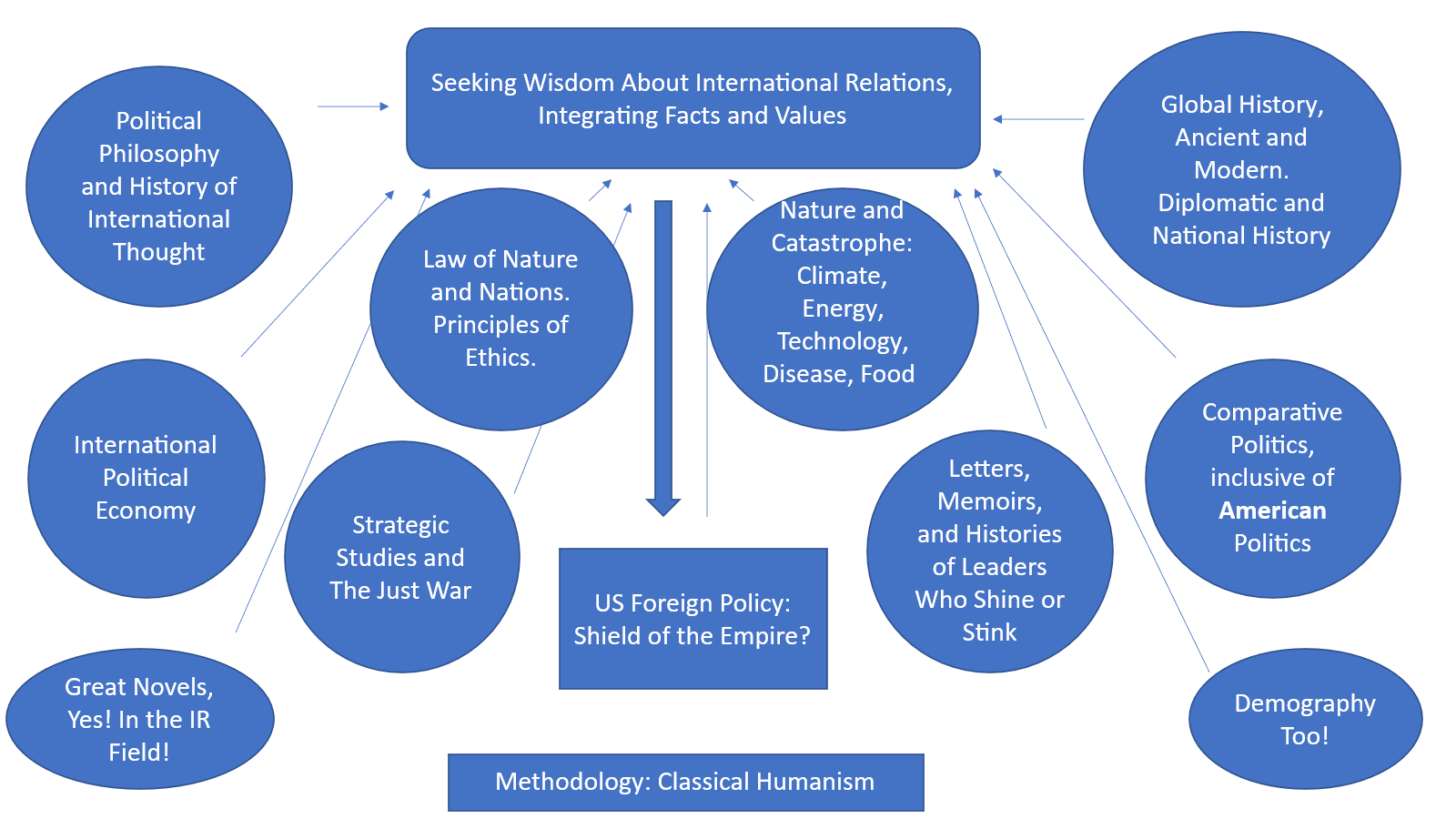
A friend told me a decade ago that graduate students in Political Science at a highly-ranked American university were informed by their doctor professors that they would not be responsible for anything written before 1980 in their comprehensive examinations, one of the critical steps on the road to a Ph.D. This book was not composed with any special animus to things written since 1980, from which I have profited greatly, but it is informed by the idea that the world before 1980, and the people who lived in that world, have a lot to teach us. We must not restrict our quest for knowledge of international relations to debates among contemporary academic theorists but must open wide the floodgates of knowledge from a variety of different disciplines. A nineteenth-century writer on the law of nations once speculated on the sorts of knowledge necessary for someone to become practiced in that science: “all philosophy, all history, and all diplomacy” was his answer.1 We would not be contravening the spirit of his answer by extending our inquiries beyond that. The following figure—The Field of International Relations, Revised Edition—displays in brief how I see the field.
A classic recommendation about what one needs to study in order to understand international relations (or better yet, act as a representative of your political community) comes from John Adams, among the first of America’s first diplomats. The ideal foreign minister, Adams wrote, needed
an education in classical learning, and in the knowledge of general history, ancient and modern, and particularly the history of France, England, Holland, and America. He should be well versed in the principles of ethics, of the law of nature and nations, of legislation and government, of the civil Roman law, of the laws of England and the United States, of the public law of Europe, and in the letters, memoirs, and histories of those great men, who have heretofore shone in the diplomatic order, and conducted the affairs of nations, and the world.2
Adams’s list of prerequisites is pretty expansive, but from a twenty-first-century perspective it also appears a bit blinkered, like those things they put on racehorses. He probably wouldn’t mind too much if we updated and modernized his expression. To the histories of the four countries named, we would need to add a lot more, with special attention to the historic experience of Germany, Russia, China, Japan, Indonesia, India, Pakistan, Turkey, Iran, Israel, Egypt, South Africa, Nigeria, Brazil, Mexico, and Canada. We can’t become an expert in everything, but some of them, at least, we should want to know deeply, thickly, intimately, gaining an appreciation of their distinctive histories, idiosyncratic characters, and contributions to humanity, which all their peoples have made.
Nor ought we to neglect the small states, the majority among the world’s some 190 states. Most of these little peoples have memories of oppression from the larger states in their vicinity or from across the seas; as more or less disinterested observers of great power rivalries, they often have trenchant things to say about how the most powerful states are behaving. This is an important lesson to remember: since the weak, by definition, lack “hard power,” they must rely on persuasion. It sometimes happens that they lose the immediate battle but can still gain adherents by their appeal to normative truth.
We might get by with only a very skimpy knowledge of the Roman civil law and the laws of England in our IR curriculum; we’ll cross that out and leave it to the antiquarians, but keep “an education in classical learning,” even though you won’t have much time for that. Don’t skip Rome in your classical excursions, as has become a surprising tendency in modern IR instruction, with an analytical focus entirely on Greece. Greece is the outstanding classical example of “the international anarchy.” Rome is the outstanding classical example of the world-conquering empire. These remain feared possibilities in our twenty-first century world.
Indubitably, we need a knowledge of global history, ancient and modern, and we most emphatically need a thorough acquaintance with the principles of ethics and the law of nature and nations. Adams’s advice on that score is as good now as when it was written. After 250 years, I responded to Adams’s call with Restraining Power: The Law of Nature and the Theory of International Relations.
The people whom Adams had in mind, when he spoke of the “great men” who shined, were figures like Fleury, Clarendon, Somers, de Witt, Marlborough, and Bolingbroke, names that most of you would not recognize. All right then, substitute more recent figures like Mikhail Gorbachev and Eduard Shevardnadze of the Soviet Union, George Washington, Abraham Lincoln, and Franklin Roosevelt in the United States, or William Pitt, William Gladstone, and Winston Churchill in the United Kingdom. Take in great Indian leaders like Jawaharlal Nehru and Mahatma Gandhi, or the American civil rights activists who became Gandhi’s disciples, like Martin Luther King, Jr. Gather round the council fires of the Iroquois League, the first great instance of federal union in North America. Discern the suppleness and wisdom of Chinese leader Deng Xiaoping, the little man who made China rise. Instruct yourself in profound moral greatness by learning about the life of Nelson Mandela, a victim of apartheid who emerged from twenty-seven years in prison preaching love and reconciliation.
The “man in the arena” is seldom found on inspection to be a wholly admirable figure—all those mentioned above have been subjected to harsh criticism—but in their struggle to bend History to their will there is also much to admire and perhaps to emulate. As spectacle alone, these Sisyphean labors command attention. They afford additional instruction because political leaders are the main carriers of “international thought,” far more important in driving history forward than mere academic scribblers. This is a fact that academic scribblers tend to forget.
Do not avoid history’s villains, like the megalomaniacal Alexander the Great in antiquity, or Adolf Hitler, Joseph Stalin, and Napoleon Bonaparte of more recent vintage. Napoleon was a greatly hated figure for the generations that lived after him in America, Britain, Germany, and Russia. “The pedestal of [Napoleon’s] fame,” recalled James Madison’s eulogist, “was composed of the carcasses of three millions of his kind, cemented with the blood of his victims, and bedewed with the tears of their widows and orphans: his ministry seemed to be that of a ruthless instrument of vengeance to chastise and humble a guilty world.” When those words were written, in 1836, no one could have imagined that Napoleon would be followed in the twentieth century by figures who made the Corsican look like a brilliant and hard-working Eagle Scout. Hitler and Stalin polluted the memory of Europe forever, denying Europeans the solace that there was a God who looked after them.
Female students should not feel left out. Among the most formidable leaders of the last half-century were Golda Meir of Israel, Indira Gandhi of India, Margaret Thatcher of Great Britain, and Angela Merkel of Germany—most of whom were war leaders, and all of whom were political masterminds. In more distant times, there are also imposing female leaders—villainesses like Catherine de Medici, who ruthlessly ordered the massacre of thousands of Huguenots in France on St. Bartholomew’s Day in 1572, and heroines like Elizabeth I of England, who was a favorite among America’s Founding Fathers.
Alexander Hamilton, aide de camp to George Washington and in recent times the star of a Broadway musical, wrote a beautiful remembrance of Her Queenship. He considered Elizabeth’s reign as “among the most illustrious in history.” He brought her up in a pamphlet he wrote, under the pen name of Phocion. He was trying to convince his fellow New Yorkers that the loyalists should be treated fairly. Stop, he said, with the unjust proceedings. Concede their rights of citizenship, forgiving and forgetting their past loyalty to the British king, and they will love you for it. Treat them unfairly, and you bring about the thing you most fear, a disloyal segment of the population ready to turn to foreign succor. He adduced two great examples from history showing the wisdom of leniency, of knowing when to forget.
How wise was that policy of Augustus, who, after conquering his enemies, when the papers of Brutus were brought to him, which would have disclosed all his secret associates, immediately ordered them to be burnt. He would not even know his enemies, that they might cease to hate where they had nothing to fear.
How laudable was the example of Elizabeth, who, when she was transferred from the prison to the throne, fell upon her knees, and thanking Heaven for the deliverance it had granted her from her bloody persecutors, dismissed her resentment. “This act of pious gratitude,” says her historian, “seems to have been the last circumstance in which she remembered any past injuries and hardships. With a prudence and magnanimity truly laudable, she buried all offences in oblivion, and received with affability even those who acted with the greatest virulence against her.” She did more, she retained many of the opposite party in her councils.
Vengeance and retribution are as old as political life and have not lost their potency. But we can see from Elizabeth’s example that there is sometimes a different way of proceeding, what our Indian fathers called “burying the hatchet.” Perhaps the “models” we most need in understanding international politics are not composed of assumptions and theories, but of dead people who did exemplary things, like the illustrious Queen Elizabeth.
The central objective in researching these disparate fields is what Aristotle called phronesis—wisdom about the field of international relations that seeks an integrated consideration of the “is” and the “ought,” facts and values, empirical theories and normative boundaries. In this quest, all the fields of study identified in Figure 1 are necessary to the subject and must therefore be considered as belonging to it. I don’t want to step on anyone’s toes, as each of these areas of understanding has its own specialists. They might laugh if told that an eccentric professor had said they were simply a subfield of the larger field of International Relations. An act of academic aggrandizement to rival the worst conquerors in history! Rat that bastard out to the Dean of the College!
But I don’t mean it that way. I mean simply that they are part of the general inquiry that must be conducted. As they are integral to the subject of international relations, their study should be intrinsic to the discipline. If from the vantage point of these specialties the experts address problems common to international relations—as all of them do some of the time, though not necessarily all the time—they are fellow travelers in the common inquiry and should be considered soldiers (nay, at times commanders) in this IR enterprise. We want “a discipline” that will allow us to espy a comprehensive understanding—i.e., wisdom. We start up the mountain with that in mind, though realistically none of us is likely to scale the top. But sometimes you can look up to those who have and will be grateful for the view.
One would be hard-pressed to say which of these specialties is most important, because they are all important. The situation resembles what in agricultural science is called Liebig’s “law of the minimum.” It holds that growth is dictated not by total resources available, but by the scarcest resource or limiting factor. If you deprive them of one crucial nutrient, the rest suffer and may wither and die. No nitrogen, no nuthin,’ even if you load your plant life up with lots of other good stuff. Thinking about that analogy, I’m forced to admit that we wouldn’t all fall down in total ignorance if Comparative Politics were thrown off our figure, but what would be the point of doing that? We are to look only at the “outside-in,” not also the “inside-out”? The truth is, we should be wounded in our understanding of international relations if any one of these rich veins of knowledge were to lie unexploited or ignored; something big would then be missing.
These methodological and substantive commitments account for the overall shape of my library.
Most are fairly self-explanatory, but there is one general domain of knowledge, which I put under the heading of “Nature and Catastrophe,” that deserves further explanation. Thirty years ago, Daniel Deudney observed that the influence of nature on society, once a richly explored theme in political speculation, had been expunged from social science theory in the post-1945 period. Deudney argued that we needed to “bring nature back in,” but with recognition that new inventions and technologies have created an unprecedented relationship between humans and nature.3 Nuclear weapons, climate change, energy security, pandemics, artificial intelligence, and genetic engineering are part of this new material reality. Together, they raise a central question: has the vast change in material conditions enabled by technology tempted nature and created conditions in which nature will “strike back”? Is “machine civilization” hurtling humanity to disaster, as a vast literature in the humanities, the natural sciences, and the social sciences now warns? If the answers are “yes,” it may appear to displace the importance traditionally vested in the war and peace problem. But the “geopolitical” and the “ecological” domains are in fact closely related: the more that the relations of nations are fractured by great power rivalry and endemic conflict, the more remote, inescapably, will be effective political responses to existing global challenges. The Powers can’t cooperate on just about anything under those circumstances.
Next door to “Nature and Catastrophe” on the figure, you can see that I want “to bring nature back in” to IR theory as well. “Nature,” wearing a different disguise each day, as is her wont, needs to be firmly reset within both empirical and normative theory. The modern teaching on the law of nature threw the baby out with the bathwater. I want to retrieve it. To defend the law of nature and of nations as the preeminent theory of international relations is the “big idea” of Restraining Power.